 |
| Source |
Social Media Security, Social Media Policy ... What?
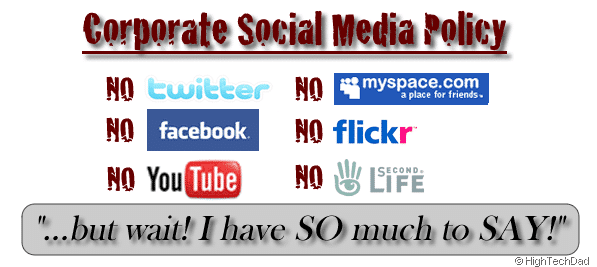
SOCIAL MEDIA POLICY
 |
| Source |
SOCIAL MEDIA (NETWORK) SECURITY

What it is. Social media security is essentially employing ways to protect you while interacting and networking with others in a social online environment. Such examples include passwords, privacy settings, protection software (mal-ware), etc. Social media (networking) security is acknowledging that privacy is lost once it hits the cyber waves.
Protecting oneself in this socially connected society is important. The appropriate action to protect oneself is not difficult. It takes time, effort and a little smarts. Check out my mini checklist to get you started in smarter social networking:
Check list
- Strong Password. Be encouraged to create a strong password. Be smart. Many are guilty of using answers to common information such as pet’s name, mother’s maiden name, or perhaps middle name. Think first – most of these are included somewhere on your social profile. Facebook has an app that enables you to list family members – voila – mother’s maiden name. You’ve uploaded a photo of your adorable four-legged friend to your social profile – viola – most likely you have included his/her cute little name (who doesn’t like to brag about their adorable pet).
- How can I create a strong password? Think numbers, special characters (if allowable) or perhaps create a phrase. Example “IL2M” means “I Love 2 Meditate” (yay! I included meditation) – maybe throw a random number at the end.
- Avoid using the same password for every site you visit. Thieves break one password and they have your entire social world at their finger tips.
 |
| Do you dare? Click here to try. |
- Think before you click. If the content you are sharing or posting to your social network isn’t something you would prefer your employer, grandmother or future mother-in-law to see… DO NOT POST IT. Once it has hit the Internet it is nearly impossible to erase its digital footprint.
- Employees leave your ranting for behind closed doors. According to the National Labor Relations Act employees are allowed to converse with each other about workplace conditions. The kicker – if you post inappropriate statements without “engaging in dialogue with other employees” you are no longer protected. If you want to gamble your career just be sure a fellow employee is engaging in dialogue with you (Halpern & Gardner, 2012, para. 2). Disclaimer: I will not be held responsible for your pink slip.
- Protection. We ask our employers to protect us from sexual harassment, workplace violence, etc. Social media is another policy employers retain the right to enforce (with limitations, yes). However if a social media policy is “implemented in response to union activities are particularly scrutinized” (Halpern & Gardner, 2012, para. 9).
For many, social media is a private activity therefore leading one to feel as if an employer’s involvement or governing is unethical. But this is where you set yourself up for disaster. Believing that anything you have or do on the Internet is private is blissful thinking. The Internet brings many advantages to our society but not without disadvantages accompanying it. Value the protection offered by your employer and the privacy settings presented by networks – but it comes down to you – be smart – the Internet opens your house to many many doors.
Some closing thoughts...
 |
| Source |
References
Halpern, S. J., & Gardner, C. H. (2012, December
3). When is Your Company's Social Media Policy an Unfair Labor Practice?
Retrieved from National Law Review:
http://www.natlawreview.com/article/when-your-company-s-social-media-policy-unfair-labor-practice-recent-nlrb-decisions-
Mitrano, T. (2006, January 1). A Wider World: Youth,
Privacy, and Social Networking Technologies. Retrieved from EDUCAUSE:
http://www.educause.edu/ero/article/wider-world-youth-privacy-and-social-networking-technologies


Hi Krystal. Great post (and graphics) about online security and policy in the workplace. I like that you made several points regarding secure passwords. Until this week's readings, I hadn't really thought about that fact that other people could guess my password because my mom has listed her maiden name on Facebook or I post pictures and comments about my pet. Little things like these can get us in real trouble, but they are often overlooked.
ReplyDeletePassword security is just as important for professional use as it is for personal use. If your work passwords are compromised, your company, coworkers and anything confidential can be put in jeopardy. Many companies do have password guidelines in place, but employees need to be aware of the potential threats in order to become as secure as possible.
What recommendations (aside from password security and thinking before clicking) do you have for individuals? We read about identity theft and burglary attached to social media use this week. What can you recommend to help individuals minimize risk in their personal lives? Someone who meditates regularly probably values a calm and organized lifestyle. Identity theft and other crime would undoubtedly cause unnecessary stress.
Courtney,
DeleteIf you haven’t tried the password test (located in my post) you should definitely try it. Let’s just say that my password could have been broken within 49 days by a PC computer – so that password is now my previous password. My new one (or ones) will take 4 billion + years to break. It’s really an interesting gadget. Gives you pointers to make your password more secure, which is an added benefit.
I must say that the U. S. government social networking training module outlined some great pointers for social media security for individuals. In addition to those I included in my post I really favored:
• Do not enter your middle name anywhere on the Internet. I found a rather interesting article about Top 16 Pieces of Your Information Identity Thieves Crave (http://manvsdebt.com/top-16-pieces-of-your-information-identity-thieves-crave/). I think many of us are used to filling out details fully without much thought. But it seems the middle name makes it much easier to become a victim of identity theft.
• Do not befriend anyone you do not know personally. With my experience in social networking there are numerous people whom I know that have 500+ friends on their list. The likelihood that they know all on a personal level seems rather unbelievable. These particular people seem to be easily influenced in becoming friends – then these ‘new’ friends attempt to become friend with you. Sticking to those you know really limits your availability. I was also shocked to see how many fake profiles are really out there. I referred to Catfish (http://edition.cnn.com/2013/01/16/sport/manti-teo-controversy-catfish) on our Facebook group page and this entire show is based around fake profiles. This show touches on personal lives and the true reality that the Internet allows anyone to become anyone they please. Trusting on the Internet often leads to frustration, heartache or betrayal.
Haha, my passwords are not at all secure! One was only 11 hours. Although now I am hoping that the site wasn't a scam to steal my terrible passwords. Looks like my passwords need a nice big overhaul.
ReplyDeleteI also felt the military module and articles give some great pointers. It seemed to do a good job of explaining why social media is important and how to use it, while still scaring you enough to be safe.
I honestly never though twice about my middle name. Plenty of the items on the the Top 16 list are very obvious, but others, your hobbies, employer and email address, are all standard on most social media accounts. I asked Nia on her blog: how realistic do you think is it to expect people to remove some of this basic info from their profiles? Do you really think people will delete their birthday or educational background?
Courtney,
DeleteI thought the module on social media was really insightful as well. I couldn't stop thinking about my brother the whole time (he's in the Navy). It made me wonder just how much training and guidance is provided in the military regarding social media, I would imagine quite a bit.
I have to say that I don't publish my birth year online because I don't feel like random people I'm friends with need to know, not really because I was nervous about identity theft. I never thought about hobbies, however. That is a clever way of trying to get close to someone. Realistically though, if I don't know you I am not going to accept your friend request because we both like chihuahua's. I most likely would not remove this info. On the other hand I would never publish my phone number or make my email visible because I don't want to be contacted in that way, I kind of don't know why anyone would.
The interesting thing is, in another lesson (about creating a good social media profile) we were instructed to put accurate and detailed information about ourselves- like hometown, or current location. It seems conflicting.
Realistically I do not think getting people to change basic information will be easily managed and my initial reasoning is because it is difficult. These social sites are oftentimes hard to navigate. Throughout this lesson I have come across numerous infographics about Facebook's settings. Basic settings include what shows up on your timeline. Many of these basic settings have been outlined in our teachings to be deleted. I also found a blog that keeps you up-to-date with it the social settings. With these difficult navigations it makes it frustrating and for some impossible to modify their profile's contents. I must say these difficulties are all part of the objective for social sites. Your personal information open to the public -- allows them to increase revenue.
DeleteYou're right, Krystal. If we take certain personal information off our profiles, sites will not have any information to sell. Therefore I would image companies might make this difficult to do, as you said, or at least discourage it. Also, when you sign up for most sights they prompt you right away to fill in all sorts of information. They give people the impression that everything must be completed. A casual user who does not know much about certain sites will not initially question the prompts for detailed information.
DeleteYou bring up a great point when you spoke about the ways which social sites essentially force you to fill out your personal information when initially signing up. I agree, a casual user would ideally be under the impression that he or she would not be able to participate in social networking without providing the detailed information. If we look at social demographics 46% of Facebook users are 45 and older meaning that many of these participants were not born in the age of such severe connectivity (Skelton, 2012). It is a new concept to them and while we may assume they would be more cautious one could argue that they are more trustworthy because nothing of this nature has ever been presented to them previously. Behind your closed door you should feel safe but the Internet opens that door to many and often times I see myself arguing that with my grandparents (who are Facebook obsessed).
DeleteIf you have a moment I encourage you to read through the infograhic that speaks further into social demographics. http://rack.0.mshcdn.com/media/ZgkyMDEyLzAzLzA5LzEwXzM1XzIzXzE0Ml9maWxl/5c5b31fb
References
Skelton, A. (2012, March 9). Social Demographics: Who's Using Today's Biggest Networks [INFOGRAPHIC]. Retrieved from Mashable: http://mashable.com/2012/03/09/social-media-demographics/
Krystal,
ReplyDeleteGreat post, I especially like the info you put at the very end. This weeks lesson has really made me hyper-aware of how easy it is to take somewhat common information and find out what someones social security number is (scary). In relation to social media sharing about work, I am always very cautious. Although I have been tempted, from time to time, to share a gripe about how busy it is or something like that, I don't because it makes me fell vulnerable and exposed. I would hate to lose my job over something silly like over sharing on social media. The funny thing it, I see my co-workers doing it all the time! I have to admit that I don't think my company follows us too closely, but still!
The protection that employees have under the law for group engagement in discussing an employer is something that I find a little surprising. I guess there is strength in numbers. You would think that would be frowned upon more so than just saying something quick to get it off your chest. Did you find that surprising at all?
In addition to having those moments when you may feel the urge to rant a tad on your social sites we must remember that in social networking our statements can be taken in many different tones. There have been times when I have stated things and received messages from fellow friends expressing their concern. I later realized that they took my message in a completely different tone than I meant.
DeleteI do agree with you that losing your job over sharing information via social networking is not on my ‘to do’ list and I am strongly against it. Brings us back to Mark’s post on our Facebook group – is it alright to bash your boss on social networks? While it may be ‘right’ according to law it is not wise according to our job status.
In regards to your question, I did find it surprising that ranting was essentially allowed if others engaged with you. Thanks for your response!
-Krystal
The fact that the same statement can be perceived in several different ways is a very good point that I think some people forget. It just doesn't seem like it would make a job any easier if your boss knew you said distasteful things about them online. It's definitely not a situation I would want to find myself in.
DeleteKrystal, excellent as usual. Your section on password security and ways to beef up your social networking safety through these strategies is great. I don't know why it is across the board difficult for everyone to consistently remember to change passwords, and remember to make passwords strong and difficult to break. For day to day use, I think this is one of the most important realms. Especially because of the lack of effort it takes, even a mediocre hacker, to break into an account. I know three sites off hand where you can go, and hire a code expert to break in to anyones gmail, facebook, paypal, linkedin, etc.!!! it is unbelievable. for the total sum of $10 your account can be breached by anyone, anywhere. And this is just an example of people who are trying to get in to your accounts. What is even more of an ongoing threat are the cyberbots that hack and infect your accounts (or steal your information) without any human involvement.
ReplyDeleteI agree Kris. Having a strong password is important but all too often many do not pay attention to it. I see more recently whenever you need to enter a new password it measures the strength for you while doing so. I see that it is very common for people to use the same password on many different sites. It is almost as if convenience outweighs the need for security. Scary.
DeleteKrystal, your comment made me think of something. I was really blown away a couple months ago...I am involved in a really cool startup business, and a lot of it involves internet reputation management and presence building. The whole idea of 'Captchas' (the little word puzzles that show up on websites to confirm the user is a real person, and not a netbot). Well, I found out that there are actually many services on the interent where you can buy Captcha Tokens, for something like 10 cents per token, that will allow spam bots to beat the captcha security. This totally blew me away. It made me feel much more secure to think that there was no way a spam bot could ever get through a page with captcha, only to find out its more simple than many other forms of hacking.
DeleteHi Krystal. I found this article this morning and wanted to post it for everyone in our group, tying in privacy, security, policy and the law. A women has been trying to get access to her deceased son's Facebook account. Some consider it a digital asset, but social media sites and certain laws consider it against policy to access someone else's account. What are your thought about this article and what can we apply to it from this week's readings?
ReplyDeletehttp://www.npr.org/templates/story/story.php?storyId=173223955
Courtney,
DeleteTough question to say the least. While I can relate to her frustrations and hurt surrounding the limitations of accessing her son's site. However from a business standpoint they must enforce ones privacy. Perhaps in the future the sharing a death certificate would open access or as Kris mentioned above - hire a hacker - $10! ;)
-Krystal
You're right, the companies are just enforcing the rules. I do think, however, that situations like this are only going to increase. It might be in the best interest for everyone to evaluate the law and policies regarding death and digital assets.
DeleteHi Krystal,
ReplyDeleteI know you said you didn't know how to tie meditation into this weeks blog. Well, after reading it, I would say that people who follow your advice on how to protect themselves on social media will have an easier time meditating- they won't be worried about their accounts!
After reading your checklists, I actually went and changed my passwords. While mine did not have anything to do with my name or street I grew up on, I do feel that a skilled hacker could figure them out. Thanks for the tip! Also, I set up something a while ago for anything using a Facebook app. While I have a password, anytime I log into my account on a new computer, Facebook sends me a text with the code to use as my password. So that way, I can ensure that it is me logging in. If I get a text with the code randomly, I know someone was trying to hack my account and I can alert Facebook. It does make me feel better. Have you heard of any other tools like this available on popular social media sites?
Kate you are so kind. I tried to relate this post to meditation. Without success, or so I thought, your comment was reassuring. Thank you!
DeleteI actually changed my passwords as well. I tried the gadget I shared in my post and although my password measured as strong it could be cracked within 48 days by a PC computer. I too use some similar but with my Google account. Whenever I attempt to log into my Google account from a strange computer it requires a passcode. I feel this is a great tool for security. Many times cookies in computers store your information, including passwords, and if used on public computers people could access your personal information simply by opening up the site you exited.
As for any other tools like this, I am not aware of any actually. I can argue whether these social sites really want us as secure as they express. Hmmmm, thoughts on that?
-Krystal
Hi Krystal,
ReplyDeleteI think that people not understanding social media is the number #1 reason it gets them into trouble. You give great tips on how to better secure social media pages. Do you think the social media sites should be held accountable? Should they be forced to divulge the risks people are taking when people first sign up? It would kind of be like a "warning" when you first register. Another way to inform people would be to require social media hosts (like employers) to update people on what kind of new scams or risks are out there. It could scare people away...but its just a thought.
Nia
Hi Nia. I do think social media sites should be somewhat responsible for educating people about the risks of social media. However, it would be very hard for them to enforce anything and be sure people actually learn anything. Employers, on the other hand, have a much higher stake in the safety of their employees than sites do with users. It would definitely be in a company's best interest to educate employees. Perhaps a required training program or module, like the one we completed this week. Even providing employees with basic information and tools is better than nothing, in my opinion.
DeleteHi Nia,
DeleteI can agree with you that perhaps those behind the operations of social media sites should be held more accountable to warn individuals of the risks connectivity possesses. But on the contrary this is when the role of business steps in. These social sites make money, more money, when their participants do not make their information private. Marketers are finding social media as an ever growing intelligent tool for truly understanding each consumer. Personalization is growing more now than ever. As Scott has mentioned in his book, niche markets are the wave of the future rather than mass media. I think if these social sites try too hard to make individuals aware of the risks involved in social networking they see dollars disappearing. Therefore they cover their ethical responsibilities by offering privacy settings, whether one uses them is up to them. But essentially I think this gives these businesses a feeling of 'clean hands.' Is it ethical? One could argue either way. Great question!
-Krystal
"Clean hands" is a good way to describe it, Krystal. Policies are stated and available to users, but it's not a sites fault if they don't read them carefully. It gives sites a little freedom to get the information they want to make money, but still "protect" users at the same time. I'm sure the ethics of the situation are vastly different on all sides of the equation.
DeleteGreat job this week, Krystal! Thanks for your post and comments. I've just posted a quick recap of the week in our group forum. Thanks again!
ReplyDelete